

Presidents Plate Award
The British Puppet Guild's President's Plate has been awarded to its members since 1967. Each year, the President in office will choose someone who they think has contributed significantly during the year, and present them with the coveted plate. This is usually kept a secret, with the winner's name only being announced at the end of the President's speech at an AGM. The plate has the winner's name engraved onto it, and they get to keep it for 12 months.
Over the years many well-known figures in the world of puppetry and toy theatre have received this honour. Here is a list of the recipients, some of whom have a personal profile on the website.

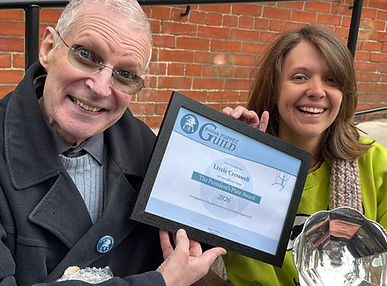
2026
Lizzie Cresswell
Lizzie's company, Cresshead Puppet Productions, is based in South East London. Like most puppeteers, she has loved puppetry from childhood, and used everyday things to create characters and mimicking voices to entertain herself. Lizzie fell in love with Sesame Street, The Muppets, Labyrinth, but was fascinated with storytelling and how it can affect an audience. When she started puppeteering in a local preschool she found her dinosaur character kept the children’s attention, helping improve the focus and learning of children who struggled to concentrate.
.jpg)
2025
Brian Hibbitt
Another two-time award winner, Brian Hibbitt has been at the core of the Guild Council for decades. As treasurer, he is entrusted with all the organisation’s financial responsibilities. Alongside this, Brian has been integral to devising new systems when changing websites, suggesting and marketing new merchandise to provide new income streams. Additionally, as the editor of The Puppet Master for many years, Brian has made use of his considerable experience in the field of printing, ensuring that this annual publication makes its way to a growing membership base on time, and is always packed with current news from the UK and abroad. Beyond the Guild, he is the honorary treasurer for PuppeteersUK, and for the Puppet Centre Trust. Brian is a very long-term member of the Guild Council. He has played many roles but has made his most valued contributions as Treasurer and editor of The Puppet Master.

2024
Mary Pollard
In the summer of 2024 Mary was awarded the British Puppet Guild’s President’s Plate, presented to her by Guild President Ronnie Le Drew. Originally awarded by Cecil Madden in 1967, nearly every year since this gleaming silver chalice has passed on to a Guild member deemed to have contributed a significant amount to the work of the Guild and to the field of puppetry in general. Mary’s contribution was for work on the Guild newsletter, social media, website and more widely as a reviewer and journalist, and an advocate for puppetry.

2023
Lee Thompson
Lee's contribution to the Guild’s online presence has been an absolute game changer, giving new visibility and increasing membership numbers significantly. Lee Thompson is an award-winning professional Puppeteer based in the U.K. Lee has worked as a Puppeteer for over 20 years and has appeared on multiple television productions. He has worked on puppetry projects across America, India, Thailand, Iran and New Zealand. Creating corporate, music, comedy and educational puppet videos. Lee has also won awards at puppet festivals and is on the Council of the British Puppet Guild. Lee is very passionate about puppetry and makes content from his home studio and frequently releasing videos on his social media platforms. His work has been showcased at Puppet Slam events and Puppet Festivals internationally. Lee's Profile

2021
Michael Dixon
Michael has made a significant contribution to the Guild as Chair and Archivist across decades. He has been a member of The British Puppet and Model Theatre Guild since the age of 14. His interest in puppetry began at an early age whilst watching a series of The Muppet Show. Michael was fascinated with the Muppets and wrote to many people in a bid to meet their creator, Jim Henson. He was fortunate when one Monday morning the BBC called his home. They had seen one of his letters and asked if he would like to go on Breakfast TV the next morning and interview Jim Henson who was scheduled to appear to talk about his new show, Muppet Babies. This was back in 1986 at the age of 7. And although a little nervous, his excitement far outweighed it. Jim was extremely generous with his time and kept in touch with him regularly until his sudden death in May 1990. Michael was also interested in the history of puppets, so it was no surprise when he became archivist for the Guild. As the current chair of the guild, what are his plans. He hopes to make some changes that give us purpose and longevity in a fast-changing world. The Guild is fortunate that it has a really great council at its helm, with the desire to move forward and ensure that the Guild is still relevant. Its exciting times for puppetry in Britain despite the cuts and the difficulties the arts are facing, puppetry is now more recognised here as an art form in its own right than ever before. Michael is extremely proud to be the chair of an organisation with such a rich heritage, and look forward to the future and what it brings.

2019/20
Sarah Peasgood
Sarah received the award for a second time, recognised for her role as Newsletter editor through the Covid pandemic, which didn’t miss an issue across the two years of the crisis.
Sarah is among a handful of paper & toy theatre maker-performers in the UK. Her shows have live narration with atmospheric lighting and musical soundtracks. Driven by a love of theatre and the dramatic illusion that can be created on the miniature stage, she has become a specialist of the craft with a repertoire of shows in a colourful contemporary style having honed her skills since first performing in 2008.
Repurposed and recycled materials are used in the hand crafting of these bespoke shows. Sarah's recent productions are mini adaptations of classic fairy tales for the public, but her repertoire also includes bespoke commissions and plays based on historical events. Her first shows were inspired by comic strips. Website

2018
Malcolm Knight
Malcolm has been an advocate of puppetry for countless years, both in Scotland and further afield. Malcolm published Steve Cockayne’s book on the life of Waldo Lanchester, a founding member of the Guild. Malcolm has been collecting masks and puppets from around the world since 1977. From an early training in amateur drama and operetta to performances in Shakespeare, he was an undergraduate in Drama and English Literature at the University of Hull in 1973. Between 1973 and 1975 he did postgraduate M.Litt research into the mask in modern drama at the University of Glasgow while simultaneously directing The Fellow Travellers Theatre Group. During this time, he began his exploration of Commedia dell ‘Arte and throughout the seventies travelled backwards and forwards to Italy. During 1975-77 he was a Temporary Lecturer in Drama at Trent Polytechnic in Nottingham. After a move to London, he was awarded the first UK bursary to train as a professional puppeteer with Playboard Puppet Theatre by the Arts Council of England and also commissioned by John McGrath of 7:84 Theatre Company to make the masks for Trembling Giant at the Royal Court Theatre.

2017
David Leech
David was recognised for his long term advocacy for Pelham Puppets, in addition to his work as Newsletter editor. He spent his teenage years staging puppet shows with the help of school friends and began to get invited to children’s parties, schools and other events in and around his home town of Stone, Staffordshire. David was twelve years old when he first met Bob Pelham at the factory in Marlborough in 1966. Bob took him on a grand tour of the factory and invited him to work for a few hours in the factory and stay overnight at his home. He returned the following day with a very large bag of puppets as “payment” for his work! And so began his lifelong association with Pelham Puppets. Website

2016
Gren & Juliet Middleton
Gren & Juliet were celebrated for setting up their unique Puppet Theatre Barge in 1982, and for hosting numerous Guild visits.
Gren Middleton and Juliet Rogers formed Movingstage Marionette Company in 1979. After a couple of years touring marionette shows, Middleton and Rogers bought an old 80 ft Thames lighter of riveted iron construction, built in the 1930s and converted it into a double-bridge string marionette theatre. The Puppet Theatre Barge was opened to the public on 28 January 1982 at Camden Lock in north London. Its first performance was The Rhyme of the Ancient Mariner, by Samuel Taylor Coleridge. In 1988, the barge moved to the basin at Little Venice, near Paddington. Since 2009, the barge has put on shows in Little Venice from October to June and spent the summer months, between mid-July and mid-October moored at Richmond-upon-Thames. Three generations of the Middleton family are involved in running the theatre.

2015
Dave Burgess
Dave was honoured for his dedicated work as membership secretary, which is a role he continues to perform today. His dedication has been invaluable, helping to steadily increase visibility and membership numbers. His interest in puppets began at the age of 7, when his aunt took him to London where they visited Pollock Toy Shop which was then located in Hoxton Street. Seeing marionettes hanging on the wall going up the staircase, and Toy Theatre models displayed in the shop, stimulated an appetite for the artform which he has maintained through to the present day. He is a regular contributor at Council meetings, and currently Webmaster of the Guild's new website. He continues with his lifetime hobby of marionette building, which he undertakes in his garage. He was also a regular attendee at carving weekends hosted by the late Ted & Kath Beresford, and doesn't intend on giving up on any of his puppet interests any time soon.

2014
Tysoe Marionette Group
The Tysoe Marionette Group have played a significant part in supporting marionette puppetry across generations.

2013
Joseph Peek
Joe was recognised for his inspirational commitment to the puppetry world, both as a performer and maker, while one of the younger members of the Guild. Joe Peek is a Puppeteer and Puppet Builder based in the Southeast of England. His fascination for puppetry began at the age of four after seeing a Punch and Judy show performed by fellow Guild member Chris Gasper. Since then, Joe has continued to peruse his passion for the art of puppetry as both a performer and a puppet maker. Joe has been performing his own Punch and Judy show for over 15 years and has been privileged to perform all over the county and in some prestigious venues such as London’s Covent Garden, Glastonbury Festival, Southend Pier and at the Marlborough Puppet Festival celebrating 70 years of Pelham Puppets. In recent years, Joe’s focus has been to increase his profile as a puppet maker. During the 2020 lockdown, after all performance work was cancelled, he decided to officially form his puppet making business; “Show of Hands Puppets”.

2012
Sarah Peasgood
Sarah was first awarded the President’s plate by the then President Peter Baldwin for her significant work with model and paper theatre. She is among a handful of paper & toy theatre maker-performers in the UK. Her shows have live narration with atmospheric lighting, music and sound effects. Driven by a love of theatre and the dramatic illusion that can be created on the small stage, she is a specialist of the craft, having performed across a wide range of venues for both public and private events for over 15 years. Her repertoire of handmade shows is based on popular short stories and fairy tales as well as traditional Victorian Toy theatre shows and is open to crafting bespoke commissions. Website.
A frequent author of articles on paper theatre for the BPMTG (British Puppet and Model Theatre Guild) as well as European publications; a longstanding council member of the BPMTG, advisory capacity on the board of trustees for the Pollock’s Toy Museum Trust and a member of the Hanau Paper Theatre Forum.

2011
Miraiker Battey
Miraiker was recognised for her work as membership secretary. She is a puppet carver and runs her own company, World of Puppets, specialising in children’s entertainment.

2010
Stephen Sharples
Stephen Sharples was pulling the strings in theatres for nearly 30 years, and was awarded the British Puppet & Model Theatre Guild’s coveted President’s Prize for his outstanding work in puppetry in schools and festivals across the country. He was from Caergwrle, North Wales, and was first introduced to the profession in London, when he was involved in a performance on the Puppet Theatre Barge, a floating 60-seat theatre on the Thames. He said: “I had studied design and was interested in woodwork. I had made some props and scenery for theatre shows and the company Movingstage Marionettes, asked me if I wanted to work with them for a while. I did a few shows and I was hooked.” He spent most of 20s in London doing various performances, then in 1993 he moved back to North Wales and set up his own business, Treasure Trove Puppet Company. Stephen had no idea he was about to be presented with the President’s Prize when he went to watch another of Movingstage’s productions – again on the Puppet Theatre Barge. He added: “It got to the interval and they said there was a very special announcement they had to make, then presented me with the award." It was quite poignant for him to receive the award on the barge as it was there that he was first introduced to puppetry and where he first operated a puppet in front of an audience. It was an honour to be thought of for an award and to be mentioned alongside names of those whose work has inspired him.

2009
Stephen Novy
Stephen began his puppet life in 1983, aged 40. He got a kick-start by having a step-mother and a step-father who both made wonderful puppets. He started late but lucky. at the Puppet Centre beginners’ course he made his first puppet, brought magically alive by Ronnie le Drew in two or three precise moves. In Stephens career he made puppets with paper layer, papier mâché, plastic wood, fibreglass and foam – but never wood. Above his head he performed glove and rod plays; out front (or in view) rods, large puppets, and tabletop, but never marionettes. His most successful plays were The Three Pigs & Red Riding Hood, which he often performed in French. His most demanding play was the Irish legend of Sweeney, and proudest achievements were Edinburgh 4stars for The Man who lost his Nose (Gogol), and Tea with Grandma BBC TV. The best thing however was spending 30 years with puppeteers, the Guild, and puppets.

2008
Clive Chandler
Clive is a member of the Punch & Judy College of Professors, the Punch & Judy Fellowship, a former Chair of The Puppet Centre Trust and the founding chair of PuppeteersUK.
Clive Chandler has been a full-time professional puppeteer for over 30 years. After graduating in Drama in 1980, he visited Spain. While there, he was inspired by a street theatre festival he witnessed, and taught himself stilt-walking. while working on stilts back in his hometown of Birmingham, he saw a Punch and Judy Show in progress. Too far away for him to watch the detailed action of the show, Clive was nonetheless taken by the general scene. In that moment he decided to try his hand at becoming a Punch & Judy Professor. Clive's Profile.

2007
Pauline Venables
Pauline is a longstanding member of the Guild, noted for her tireless work in the puppeteering community promoting model and table top techniques. When giving talks and demonstrations Pauline is often asked "When did you first become interested in puppets?" She can remember from the age of nine, when she made a model theatre in a shoe box. The scenery moved across the back on rollers, and she performed to her friends and their younger siblings at the garden gate. Pauline’s life in puppetry seems to have come full circle! Later, she loved the animated films of Lotte Reiniger and the illustrations of Jan Pienkowski, and whilst at college she made a shadow show of the Russian tale Baba Yaga the Witch whose house roams the forest on hens’ legs.

2006
Jon and Ann Beeny
Jon & Ann were recognised for services to puppetry, establishing Tysoe Marionettes and hosting meetings. More info to follow.

2005
Michael and Mar Dixon
In this year, Michael Dixon led an effort to prevent the Lanchester Grand Circus and Underwater Ballet from being sold overseas. Although some of the remaining Lanchester marionettes had already passed into private hands and were subsequently acquired by a museum in France, the most significant puppets were still available. Recognising their importance, Michael prepared a Heritage Lottery bid to secure the entire collection for the Guild’s Archive. The application was successful, ensuring that these remarkable puppets were preserved in the UK. Working alongside Chris Somerville, Michael later restaged both the Circus and the Underwater Ballet, bringing these historic productions back to life for new audiences.

2004
Joe Gladwin
Joe has a broad knowledge of puppetry, as a maker, performer and trainer and with a background in international work. In latter years, his particular interest has included toy theatre. Joe collected Pelham Puppets and made up his own stories. Soon he was altering the heads and costumes of the Pelham Puppets to suit the play. Tools borrowed from his father’s workshop were blunted, fret saw blades broken and Plaster of Paris regularly blocked basins at the family home. He learnt a lot but not quite enough! After a stint on the teachers’ course at The Central School of Speech and Drama, he began helping at The Little Angel Theatre. Hindering more like, and he moved on to serve in many ways, a part-time apprenticeship with Barry Smith.

2003
Rebekah Wild
Originally from Aotearoa/New Zealand, Rebekah Wild has worked internationally in her chosen field of puppetry for over 35 years, as a performer, puppet-maker and designer, director, coach and set designer. In London she performed in many productions for the Little Angel Theatre, never happier than in the workshop with Lyndie Wright. Based in Vienna since 2009, she has created puppets for many theatres including Theater der Jugend, Vienna State Opera, Burgtheater, Salzburger Festival, Schubert Theater, Theater des Kindes and Leipzig’s Theater der Jungen Welt. For the Vienna Volksoper production of the Magic Flute in 2020 Rebekah designed and oversaw the creation of 30 puppets. Among the directors with whom she has worked are Henry Mason, Steve Tiplady, Sarah Wright, Nora Dirisamer, Sue Buckmaster, Nina Nawalowalo and Christopher Leith. Since 2021 she is also a member of Spitzwegerich theatre collective in Vienna. In 2005, she established Wild Theatre with Gerhard Pichler, creating poetic and visually stunning works which are often dreamlike and surreal. Their shows have toured festivals around the world. Rebekah's Website

2002
Stephen Langdale
Stephen Langdale was born in 1937. His great grandfather was a Punch Professor in Whitstable and he continued this tradition. His father was Ted Harold, one time Guild treasurer and his mother Brenda a Guild Vice-Chairman. Just before the second world war, he got to know Geoffrey Robinson (brother of Clifford Heap) through his parent’s involvement in the Puppet Guild and through this he also became interested in toy theatre. He was a skilled artist and published 18 toy theatre plays of his own design and many stage fronts from 1994. He also restored and republished 26 traditional plays. These publications were issued from Yorkshire, France, Spain, Australia and elsewhere, since he was always on the move. When he died on 7 August 2022 the Guild lost an important contributor with an amazing artistic ability, who regularly graced the pages of the Puppet Master for almost 30 years.

2001
Bryan Clarke
When it comes to Punch & Judy puppets, one man is acclaimed the world over and is synonymous with their making - Bryan Clarke. When Royal Mail produced a special edition of postage stamps in 2001 to celebrate Britain’s national puppet show, it was Bryan they turned to. Bryan Clarke has been a professional Punch & Judy man for well over 60 years and has been making and supplying puppets from his workshop near Lowestoft on the east coast of England for over 35 years. Bryan is assisted by his wife Dorothy and hand carves all of the puppets himself in the traditional way from wood, as well as making lighter puppets using Papier Mâché. When you buy puppets from Bryan and Dorothy Clarke, you are getting unique, workable, hand-made figures, no two of which are ever alike. Bryan was seven when he first encountered Punch and Judy. The Second World War had just finished and his parents had brought him on holiday to Lowestoft. Bryan's passion for puppets was born after watching Punch & Judy, and more than 70 years later, it's still as strong as ever. For many years, performing as "Professor Jingles", he held three shows a day on Lowestoft beach. Now he just takes private bookings - but he also makes all his puppets and sells them to other entertainers and he's pledged to keep on going. Bryan's act has survived changing times, changing habits and changing attitudes.

2000
Chris Somerville
Chris is acknowledged for a lifetime’s contribution to puppetry, working alongside Eric Bramall, at the Harlequin Theatre. Chris also provided the Guild with their first website. Chris’s interest in puppetry and magic began at a young age, but it was when his family moved to North Wales and he met puppeteer Eric Bramall that he began to consider it as a career. Bramall was regularly performing his show at a temporary theatre created in the bandstand at Erias Park in Colwyn Bay. After each show members of the audience could, for a small extra charge, visit backstage, and be given a talk and look round a small room of puppet exhibits. It was those backstage visits that gave Chris his introduction to Eric and what led to the formation of an enduring friendship, and eventually a puppetry partnership that lasted more than forty years. Chris's Bio

1999
Peter Charlton
Peter is now retired but with a lifetime of experience in puppetry. His significant contribution to puppetry in television production was largely through his involvement in Play Away. A former Chair of the Guild, Peter has been a member since 1960. He is now retired but has a lifetime of experience in puppetry, beginning with a Pelham puppet at the age of 13. Peter’s particularly exceptional contribution to puppetry came during his years working in television production where he was, notably, the director of Play Away. He is additionally a successful writer and actor. Peter's Profile

1998
Roy Adams
Roy was honoured for his contribution to the Guild and in particular to model theatre. He was born in Maldon in 1932 and died in Walthamstow in the January of 2025. He was a librarian by profession, and for many years the children’s librarian in Walthamstow, where he ran a successful Dungeons and Dragons after school club. Roy had many and varied interests, including watercolour, tapestry work, decoupage, collage and embroidery. Primary amongst these was the passion he shared with his life partner Peter Bickersteth-Earnshaw for toy theatre. They gave many talks and public performances, and Roy developed a deep historical knowledge of the form and its history. They also amassed an extremely extensive collection of toy theatre plate, sets and complete model theatres, many of which were catalogued by plays in large red bound volumes. He took immense pride in showing these to visitors, explaining the plots of each work and their significance within the canon.

1997
Brian Hibbitt
During the time that Brian was editor of the Puppet Master the media had been full of material about the anniversary of the Battle of Britain which had brought back some dormant personal memories of Spitfires, doodlebugs and school lessons in air raid shelters. The fact that this event was more than 70 years ago, it reminded Brian of a far lesser but nevertheless relevant milestone for the magazine. Since taking on the editorship role in 1991, when his arm was gently twisted by Gordon Shapley, it prompted him to look back at its history. The first issue of the magazine was published in January 1946 soon after World War 2 had finished, and has been in continuous publication ever since. Prior to Brian taking over as editor there had been 12 previous editors who had served for periods of between 12 months and 8 years, so it seems that he has survived a bit longer than average! Brian is not immortal though and before too long we shall certainly need to search for a successor. The Puppet Master has seen significant changes in technology – the first issues were lick and stick with the pictures being inserted at the printers, but with the advent of postscript and desk top publishing all is now done on his PC and he is able to supply the finished page files to the printers who print it digitally. Gone are the days when copy was sent to him written by hand on everything from the backs of envelopes to corn flake packets, which then had to be retyped onto his computer - a time consuming task and a recipe for mistakes!
EDITORS of
The Puppet Master
Arthur Peterson 1946 – 1950
Gerald Morice 1950 – 1952
Frederick Barlow 1952 – 1954
Ken Barnard 1954 – 1956
Jan Bussell 1956 – 1960
Jane Phillips 1960 – 1964
Bill Meacock 1964 – 1973
Jan & Penny King 1974
Hilary Boynton 1975 – 1976
Doreen Slennett 1978 – 1979
Stan Parker 1981 – 1987
Dermot O’Brien 1988 – 1990
Brian Hibbitt 1991 – to date
1996
Sylvia & Peter Peasgood
Sylvia & Peter were honoured for their outstanding contributions to the field of toy theatre, and their longstanding support of the Guild. Few people have had as extended a connection with the Guild as the Peasgood family. Sylvia and Peter were a multi-talented couple, known for performing traditional model and paper theatre, but additionally skilled at puppet making (including carving marionettes and sculpting rod puppets) and also performance, with Sylvia being an accomplished actress. Their toy theatre work spanned three genres – classical English toy theatre; new plays with bespoke hand drawn scenes and figures; plus jointed and trick figures. Peter joined the Guild as a teenager and remained a member throughout his lifetime. Both were Guild Council members for decades; Sylvia was Guild secretary for many years, taking over from Gordon Shapley. She was also Newsletter editor, where Peter supported her work with illustrative caricature cartoons and numerous articles. The couple were awarded the President’s Plate in 1996 for their contributions to toy theatre making and performance and in 2017 they were additionally presented with the Guild’s Lifetime Achievement Award.
Sylvia and Peter brought their daughter, a young Sarah Peasgood, along to events, and she was to also become a specialist in toy and model theatre. Much later, she later became Chair of the Guild – the only woman to have ever held the position. In 2012, she too was awarded the President’s Plate for services to model theatre, and then once more at the time of the Covid pandemic, for producing the Guild newsletter at a time of unprecedented stress, not missing an edition despite extraordinarily difficult circumstances. Peasgoods' Bio


1995
George Speaight
George Victor Speaight was recognised for his work as a theatre historian and wrote a definitive history of Punch. He was a toy theatre specialist and a trustee of Pollock's Toy Museum. He was a theatre historian, author and performer and the leading authority on 19th-century toy theatre. One of his brothers was the Shakespearean actor Robert Speaight, who paid for some of George's education at Haileybury. Like his older brother, George Speaight was a gifted and natural performer from a young age. George Speaight was fascinated from his boyhood by toy theatres after his father bought him one from Benjamin Pollock's Toy Shop in Hoxton, and in the 1930s he professionally took up puppetry. He became known for his puppet show performances at the Bumpus bookstore in Oxford Street.

1994
Eric Bramall
Eric was noted for work with marionettes. He was the creator of the Harlequin Theatre in Colwyn Bay, the first purpose built puppet theatre in the UK, where Guild festivals were subsequently hosted. Eric Bramall’s talents were many but his genius was surely best revealed in his puppetry. In the 1940's Bramall pioneered a style of marionette presentation, Marionette Cabaret, a type of show in which the puppets are presented without stage, scenery or lighting apart from spotlights on the puppets themselves. The puppeteer is dressed in black so as to be as inconspicuous as possible and stands in full view. The puppets are on shorter strings than those worked from a bridge and perform on the floor, or rostrum, just in front of the manipulator who is standing on the same level.

1993
Jane Phillips
Jane is noted for her TV work and as creator of The Caricature Theatre in Cardiff. She edited The Puppet Master and was also the recipient of the Guild lifetime achievement award. (photo)
Jane Phillips became a Guild member in 1953. Born and brought up in Wales, her early work was with Hogarth Puppets as an apprentice to Jan Bussell. Here, she found herself involved in formative television puppetry work, such as Torchy the Battery Boy and Muffin the Mule. She additionally edited a magazine on puppet theatre. In 1964, Jane set up the Caricature Theatre in Cardiff, which became one of the leading puppet theatres in the UK – the first to be given an annual Arts Council Grant. Over 20 years the company toured often large scale productions countrywide, offered training on diverse artforms including mask, mime, physical theatre, puppets and performing with everyday objects. It also created work for television. When the company finally closed in 1985, Jane donated much of their equipment to The Scottish Mask & Puppet Centre, where it is kept today. In 1960, Jane took on editorship of The Puppet Master, initially with Jane Tyson, but then on her own until 1964, refining the format to allow for additional images. In November 2018, she was presented with the Guild’s Lifetime Achievement Award. Jane's Profile

1992
Dermot O’Brien
Dermot attended an arts orientated prep-school for 7 years where the staff ran a mainstream theatre, the Chanticleer Puppets. One year after they had performed at school, and he was hooked. He had been a member of the British Puppet & Model Theatre Guild since before 1956, where he was also Guild librarian for 14 years and Puppet Master editor for 2 years. Together with his wife Margaret, they were founders and artistic directors of the week long Stratford upon Avon Puppet Festival, which ran from 1983 for 9 years. The festival not only hosted top UK puppeteers but also performers from the USA, France and Spain. For 3 years they ran workshops in the RSC’s Swan Theatre, and performed at the Edinburgh Fringe Festival & Warwick Arts Festival. They also toured with their own Fantoccini around Warwickshire and Oxfordshire. A forty minute show full of tricks and surprises that took your breath away, which included the Mexican Skeleton and the Grand Turk.

1991
Douglas Hayward
Douglas was the Guild archivist for many years and hosted several Guild festivals. He ran a puppet theatre in Abbots Bromley, where his puppet collection was displayed. Douglas Hayward LVO, MA, first became interested in puppetry in 1940, when as a wartime evacuee to Malvern, he became a frequent visitor to the Lanchester Marionette Theatre, and was encouraged by Waldo and Muriel in the making of his first marionette. After an early career in teaching and youth work in Cornwall and Oxfordshire, Douglas was appointed to the role of Midlands Regional Officer for the Duke of Edinburgh Award Scheme, which resulted in him re-locating to the Staffordshire Village of Abbots Bromley. Here, in 1974, Douglas converted a small commercial property on the High Street into a 50-seat Marionette Theatre which opened on 3rd May 1975. Doug's Bio

1990
Mabel Crowther
Mabel first joined the Guild in 1926 and worked with all kinds of puppets, touring with ENSA during WWII. She ran an annual summer theatre at the Lido in Cliftonville. Mabel Crowther first joined the Guild in 1926 and worked with all kinds of puppets, touring with ENSA during WWII. She ran an annual summer theatre at the Lido in Cliftonville.
It was in December 1990 when Mabel had the honour of receiving the Cecil Madden Bowl. It made her stop and consider just how long she had been a member of the British Puppet and Model Theatre Guild. Unbelievable though it seemed it was back in 1925 when, together with her beloved husband Arnold, she started attending meetings with other puppeteers. The Guild had no premises then, and met in each other's houses, most often in Waldo Lanchester's flat in Hammersmith, where many happy evenings were spent. It was these early meetings that gave Mabel her love of marionettes. They were her favourite kind of puppets. This early passion also resulted in her total inability even then, to throw away any small scrap of material or trimming that might do to dress a puppet. Quite often after Mabel had given a puppet show or a lecture she would be sent small parcels of material that the sender thought Mabel would be able to use for her puppets. After sixty-six years of involvement with puppetry Mabel still found puppetry to be the most delightful and fascinating of all the performing arts. She even found herself assisting her young grandson, James, with his puppet performances. One day he asked her if she had any scraps of material that he could use to dress his latest puppet creation. Little did he know ...... !

A wooden marionette bought in about 1890 from a street stall in London by Alastair Crowley, and subsequently owned between 1934 and 1980 by the puppeteer Mabel Crowther, of Arno Puppets.
1989
Pat Brennan
Pat was a much respected member of the Guild, whose contribution to the field of puppetry was greatly appreciated. She made a significant contribution to puppetry for children’s television. She worked on shows such as Postman Pat, Little Robots and Roary the Racing Car. Pat died of a heart attack on Friday 14 October 2011. So many people owe a lot to Pat, not just for her practical help but also for her sheer enthusiasm. Pat was married to her husband Hugo and attended the 1981 Kirkudbright Puppet Festival. She was well known for educational puppetry, and it was at the Puppet festival she ran a children’s workshop with the Beresford’s and Hilda Cross. Further meetings took place at Pat’s open day’s held at Milverton Road. When Kath & Ted Beresford starting running their own puppet workshop weekends, Pat would always come and stay and contribute in some way to the content of the course. After Hugo died, Pat moved to a smaller house. Eventually Pat went into sheltered accommodation, but Kath & Ted would still visit and sometimes take Pat out for a pub lunch. When Kath died, Ted would still visit Pat, who by this time was not well enough to venture out. So instead, Ted would bring in KFC chicken and chips which they would eat on their laps and put the puppetry world to rights. Even until the end, Pat was still chatty and fully aware as she spent precious time with her daughter Patsy and grandchildren.

1988
Steve and Chris Clarke
Steve & Chris are puppet makers and performers, and long term Guild members. Their extensive practice includes marionettes, glove, rod, and shadow puppetry. Steve Clarke started making and performing marionettes for family and friends when he was about 9 years old and continued until he started National Service in 1956. The interest surfaced again after his marriage to Christine in 1960, when they joined the Guild. Steve left the RAF in 1965, and for several years concentrated on the family and home. It was after a few years into their second home that they were able to devote more time to puppets. Many holidays were spent attending Guild festivals, which were held throughout the UK.Clarke's Profile

1987
Percy Press II
Percy Press ll son of Percy Press himself, was also a Punch professor and the founder of the Punch & Judy Fellowship. He additionally served as Guild chair. Percy was not the most perfect of Punch & Judy performers, but he more than made up for that with his effervescent personality. There has yet to be another British puppet performer who was held in such high esteem abroad as Percy, and thousands were saddened by his sudden death. Also we must not forget the tremendous amount of work Percy did in this country over many years, until age began to catch up with him. Chairman of the British Puppet and Model Theatre Guild for several years, organiser of numerous functions for the Guild, in particular at the CA.A., founder of The Punch & Judy Fellowship, for many years a member of the British UNIMA Committee, eventually taking over as Secretary from the late Tom Howard, and for his endless service to UNIMA being made a Member of Honour of that organisation. Percy travelled hundreds of miles in this country and was also a loyal and dedicated secretary of UNIMA. In the early days he hosted his own meetings in Chelsea. He will be best remembered however for his time spent as Guild Archivist. He dedicated much of his time attend meetings and functions relating to puppetry, a meeting wasn't a meeting until Percy had arrived. Percy could walk into a room and suddenly the room lit up -That was special.

1986
Stan Parker
Stan travelled the world with his most famous show Stanelli's Super Circus. He was not only a performer but a puppet carver, and for some time the editor of The Puppet Master. Stan Parker was born in 1926. His father was a Punch and Judy performer and Stan took up wood carving as a young man. Soon he became interested in Marionettes or string puppets. He was very influenced by a puppet company in Stratford on Avon, called the Lanchester Puppet Company. Stan developed his puppet performances within Cumbria and soon had a repertoire of cabaret and circus, he then set off "on the road" to take his shows literally all over the world. For 25 years Stan and "Stanelli's Super Cicus" was one of two major puppet exports from the United Kingdom. Stan flew the flag not just for himself, but for British puppetry and for many years he was an active member of the British Puppet & Model Theatre Guild, and was the editor of the "Puppet Master" magazine from 1981 to 1987. He was also a member of British UNIMA. Stan's Bio

1985
Ted and Kath Beresford
Ted & Kath were hugely popular long term Guild members. Not only were they puppet makers but were keen trainers, passing their creative and storytelling skills on as their legacy. Ted & Kath Beresford were significant figures in British puppetry, known for their work as performers, makers, and educators, particularly their contribution to the British Puppet & Model Theatre Guild. Their legacy includes a lasting impact on the art of puppetry in the UK and abroad through performances, making marionettes and rod puppets, and running workshops like the "Beautiful Birds & Beastly Bugs" residential weekend. Ted and Kath were both performers and makers who created marionettes and rod puppets. They were very important to the British Puppet & Model Theatre Guild, with Ted serving as Vice President and both of them influencing many puppeteers in the UK and internationally. They ran workshops and residential weekends to teach others the craft of puppetry, including events like the "Beautiful Birds & Beastly Bugs" weekend held in April 2003. Ted had a reputation for his patience with fellow puppeteers, and few in the field in the UK had not heard of him and his late wife, Kath. Their work is remembered as leaving an "immeasurable" impact on the puppetry community.

1984
Bob Wade
Bob was a Punch showman and outstanding puppet maker, originally a student of Fred Tickner. There are countless sets of Punch and Judy figures in use today that were carved by Bob Wade, and also many Punch and Judy professors performing who went on a Bob Wade Punch and Judy course. Before ever setting eyes on a puppet show, Bob spent many years as a PT instructor with the Royal Marines. It wasn’t until the 1960’s and a chance meeting with Fred Tickner that a lifelong friendship began that would change the course of his life Fred introduced Bob to marionettes, giving him a couple which he hung up at home. Eventually he got round to using them, first performing for visiting friends and finally in public. Fred would give different puppets to Bob and finally suggested that he might be suited to Punch and Judy. The Punch and Judy puppets that Fred made for him were the same ones that he used throughout his career. Fred encouraged Bob to carve puppets himself and he clearly had a natural aptitude for it. His puppets continued to sell right up until the day he retired. Always at Bob’s side was his delightful wife, Jean, who made the costumes for so many of his puppets before Bob took on the job himself in the latter years.

1983
Ivy Bass
Ivy was born and raised in London and spent a lot of her childhood going to Music Halls with her mother. Her favourite Music Hall star was Gracie Fields. One of her earliest childhood memories of puppets was watching a performance given by the Schichtl Puppets in London. Little did she know then that puppets were to play a significant part in her life. Ivy tried many different jobs after leaving school, but it was always a struggle to find work. She would sometimes think of different money making schemes to help make ends meet. While working at a London hotel, she met her first husband Roy. They later got married and their first child Maureen was born. They decide to move to Hertfordshire, to the small village of Bygrave. It was here that Ivy and Roy had some of their happiest times together. Sadly Roy didn’t return from the war and Ivy was left to support her daughter and mother. It was some years later when she found love again with Cyril Bass. It was in 1959 that Ivy was introduced to puppets and the Guild on another visit to London. From that day, Ivy found a new passion in puppets, which was to stay with her for many years. Her first puppet theatre was built by her husband Cyril, and the Bypups puppets were born. For several years as a guild member, Ivy developed the role of the Guild Librarian.

1982
Ken Barnard
Ken was a renowned marionette maker. In 2003 Ken was awarded a Lifetime Achievement Award from the Guild. At the age of 40 Ken joined the British Puppet Guild and eventually became the editor of The Puppet Master and Vice-Chairman. Ken’s family had been involved in the puppet trade since the nineteenth century as the Barnard Mannequins and toured the world with their string figures before the First World War. His grandfather Richard was a master puppet maker, and his father and brothers travelled the world with the company. But he didn’t take up the strings until late into his thirties. The marionette became his chosen metier or trade. Ken's Bio

1981
John Blundall
John was Guild president from 1987-1998. He was an outstanding puppeteer, maker and sculptor, perhaps most famous for creating the figure of Parker in Thunderbirds. John Blundall, born in 1937, was a legendary figure for generations in the world of marionette puppetry and a key member of the AP Films team of puppeteers and sculptors from Supercar through to Thunderbirds. The son of a painter and a fine craftsman, John found his way by combining his artistic leanings (he was keen when young to become a performer) and craftsmanship. At school he was keen on drama, woodworking and metalwork. In 1951 he created his first marionette theatre, The Festival Marionettes (this was the year of the Festival of Britain), a four-person group of puppeteers and a marionette variety act. John worked in variety theatre as a Stage Designer and Stage Director, at the Dudley Hippodrome and the Pavilion Theatre, Liverpool. This form of popular entertainment was declining due to the rise of television, which was sweeping all before it with the arrival of commercial television from 1955. John's Bio

1980
Penny Francis
Penny was a fierce advocate for puppetry who wrote about a changing environment both in the UK and internationally. She was instrumental in the formation of The Puppet Centre at Battersea Arts Centre. Penny Francis did a huge amount to raise the profile of puppetry and give it credibility as a theatrical artform. A writer, editor, lecturer, activist and advocate, she was a founder of the Puppet Centre Trust in 1974, dedicated to the promotion and practice of puppetry in all its forms. Her work was key to professional puppetry performance finally being supported by the Arts Council. Penny edited the Centre’s magazine Animations from 1976 to 1992, to which she submitted many studies on puppetry. Penny was a UNIMA Member of Honour (2012), councillor (1992-2008) and Executive Committee member (1996-2004) with a mission to promote new British work abroad.
Penny was a member of the Guild until her death in 2023. Penny's Bio

1979
Tom Howard
Tom (circled in the photo) was the Guild’s archivist, whose work saw him document the entire Guild collection. He was the Guild representative for BrUNIMA and also founder of the Chelsea Puppet Theatre Group. Tom had a lifelong interest in puppetry and although somewhat of a loner, he often spent his holidays following his interest in International puppetry and I can recall one occasion when he went to Reykjavik in Iceland to visit a Guild member. Tom's love was for the complete theatrical illusion, he collected model theatres and loved marionettes performed within a proscenium stage. He had little time for cabaret performances which did not hold the same magic for him.
This interest in illusion led Tom to research in great detail such specialised troupes as the Schichtls, whose trick marionettes baffled several generations of theatre goers. For many years Tom served on the Council of the Guild, rarely missing a meeting until in later life with failing eyesight.

1978
Fred Tickner
Fred Tickner was a notable maker of Punch & Judy figures however, he also made many marionettes and ventriloquist dummies. In the 1930s he gave the first performance of Punch and Judy on British Television and also made British TV’s first iconic puppet star ‘Muffin the Mule’. Fred's Bio

1977
Percy Press
Percy Press was one of the most famous of all Punch Professors, and was Chair of the British Puppet Guild in 1950.
At the age of seventeen he became a street magician, having made his debut on Hampstead Heath. As a busking magician and fairground player he toured throughout Great Britain. He began to perform Punch & Judy in earnest in 1935. Seasons at Swanage, Ramsgate, Paignton, Herne Bay and Hastings consolidating his reputation. During World War II Percy Press presented Punch in Battledress for ENSA (the Entertainments National Services Association), which organized travelling entertainment for civilians and troops during the war years. In 1947, he performed in Punch & Judy for Renown Films and, in 1962, The Punch & Judy Man, starring Tony Hancock, followed. Percy's Bio.

1976
Muriel Shutt
Muriel Shutt was chair of the Guild for eight years. She was also a puppet maker and performer with her own puppet company. Muriel Shutt was a member of the Puppet Troupe known as The Mejandes Marionettes. The name being formed from the names of the Shutt family. Ernest Jnr (Plug), Ernest Snr, Muriel and Judith Shutt. Judith and her brother Plug (Ernest Jnr), had been introduced to puppetry from an early age. They had seen a performance whilst on a family holiday in 1951 presented by the Jonathan Laurey Marionettes, and joined the Guild soon after. The combination of Muriel’s art school training and Ernest Snr’s carpentry and metal work skills meant that a new, exciting family activity rapidly developed and soon they were all building, sculpting and performing with their own marionette theatre troupe : The Mejandes Marionettes.

1975
Waldo Lanchester
Waldo was one of the founding members of the British Puppet & Model Theatre Guild in 1926, and was also co-founder of the Whanslaw-Lanchester Marionettes. Waldo became interested in the puppetry revival of the early 20th century pioneered by H.W. Whanslaw, whose book ‘Everybody's Theatre’ was published in 1923. Lanchester joined Whanslaw to create the British Puppet & Model Theatre Guild in 1926. They founded the Whanslaw-Lanchester Marionettes a year later, based at the London Marionette Theatre in Stamford Brook. He wrote a book on the revival of puppeteering and commissioned George Bernard Shaw to write his last completed play Shakes versus Shav in 1949. In 1952, Donald W. Seager wrote that "Waldo Lanchester has consistently been associated with all that is best in the puppet theatre", while Archibald Henderson called him "England's greatest puppet master." Waldo's Bio.

1974
Jan Bussell
Jan was the founder of the Hogarth Puppet Company with Ann Hogarth in 1932. Their most famous characters was Muffin the Mule. Ann was trained as a stage manager at the Royal Academy of Dramatic Art (RADA). Jan Bussell was an actor and television producer already involved in puppetry when the two met and, looking for new initiatives in puppet theatre, worked together as full-time puppeteers. Their repertoire, for adults and children, mixed different techniques of puppetry in an adventurous range of pieces: literary dramas, children’s tales, poetry and songs, music hall and circus turns. The couple experimented with artistic concepts, notably in a cubist Macbeth with scenography by Michael Eve. The Hogarth Puppets became Britain’s best-known company at home and abroad. Jan's Bio
.jpg)
1973
Richard Gill
Richard Gill was something of a phenomenon in the puppet world. He was surrounded by an almost palpable aura of success and prosperity not common among directors of puppet companies of the period. Determination, energy and will power were his main weapons in a considerable armoury. If he wanted the moon, he would probably get it. Richard and his wife, designer Elizabeth Waghorn, founded ‘POLKA’ – the children’s theatre with actors and puppets, with the very clear aim of bringing children what they, the Gills, believed to be the very best in colourful, enchanting entertainment of the highest quality. POLKA theatre were in demand in several theatres all over the country, sometimes with bookings twelve months in advance. Richard recognised and employed talented people from the puppet world including Christopher Leith and John Thirtle, who made puppets for him. In 1978 the POLKA company opened its doors to a new permanent theatre complex which was the envy of almost every puppeteer in the Western World.

1972
Gordon Shapley
Gordon was Secretary of the Guild from 1956, later additionally acting as treasurer. He inaugurated the Guild Newsletter, which he edited up to his retirement in 1996.
Members Pay Tribute to 40 Years Devoted Service to the Guild
On Saturday 19th October 1997 a group of loyal Guild members travelled to Three Holes, Near Wishbech in Cambridgeshire to say Thank You Gordon for 41 loyal years service to the Guild. It was in 1956 that Gordon Shapley first took on the mantle of secretary to the Guild and later he also took on the responsibility of treasurer. It was only ill health that forced him to relinquish these posts at the last Annual General meeting held in Blackpool last May. Since Gordon was still not fit enough to travel from his new home, living with his daughter in Cambridgeshire, Guild members decided that they would travel to him. No Guild event is complete without entertainment, but on this occasion it was something special. Brian Clarke had the audience in stitches with his Punch and Judy and this was followed by a trip down memory lane with Ray and Joan DaSilva who specially revived their marionette cabaret, last seen by Gordon in about 1964. This proved without doubt, the lasting entertainment value of this type of show, which seemed as fresh as ever. As our chairman Peter Charlton said, it was Gordon's untiring efforts that have kept the Guild going over these last 41 years and his record is one that is unikely to be equalled. We all owe him a great debt and hope that the gifts presented to him from the Guild will allow him to fully enjoy his well earned retirement Mr Punch adds his congratulations at the celebrations at the Party Gordon's Bio.

1971
Ray DaSilva
Ray has been a member of the Guild since the 1950s. He and his wife Joan DaSilva are retired professional puppeteers, notable for founding the Norwich Puppet Theatre. Ray and his wife Joan are now retired but have spent a lifetime as professional puppeteers, both making and performing. Their experience ranges across many aspects puppetry, from Punch & Judy to tabletop and everything in-between. DaSilva Puppets was in its time the largest puppetry company in the UK, and toured for several years both in the UK and internationally. It became a training ground for puppeteers who went on to form their own companies and to work widely in theatre, television and film. Ray and Joan additionally ran a puppeteers’ bookshop and organised industry events. The DaSilva's formed the Norwich Puppet Theatre, which opened in 1980 and is still running successfully today. DaSylva Profile.

1970
E S Harold (Ted)
Ted Harold was not only Guild treasurer but was the prime mover in the restoration of the Shichtl trick marionettes, which are part of the Guild’s collection.

1967
Harold Aidalberry
Harold was not only Guild treasurer but was the prime mover in the restoration of the Shichtl trick marionettes, which are part of the Guild’s collection.
The first recipient was Harold Aidalberry, who was Secretary of the British Puppet and Model Theatre Guild from at least 1951, later Treasurer (1967), and was regularly involved in organising events. The Plate (then the President’s Prize) was awarded by President Cecil Madden for his work on an exhibition in Harrogate.
Although he left the Guild in 1968 we know that in the 1970s he was still an active part of the puppetry community, involved in developmental conversations between the Guild, the nascent British UNIMA and the Educational Puppetry Association (EPA), which resulted in the formation of the Puppet Centre at Battersea Arts Centre, the first national puppetry centre to be established in the UK. He passed away in 1975.
